Learning Places and Spaces - virtual and actual
 |
 |
 |
 |
Quite unusually, over approaching 35 years, I've had a lot of involvement with both the design of virtual communities on-line and the design of physical learning spaces like schools, companies, communitiy centres and colleges. We learn about each from the other, of course. I've been working on these future learning spaces for some many years - see this T shirt from a conference we used to run annually for example.
I now get heaps of requests for help in these areas, which I am delighted to offer, but have assembled this site as a slightly chaotic "primer" for anyone exploring these design issues. Hopefully it will be useful as a starting point, but I'm here to help with a lot more if you need it! Obviously, I do a lot of work formally in this area as a consultant, and as a professor, with many projects, from tiny community driven makeovers to vast multimillion pound global projects spanning decades. If I can help, please do mail me:

I have not offered any kind of narrative to link through of this; you will find a few useful articles and papers from my writing retroBlog and some vidoes in my heppell.tv blog, but the collection here is really just a treasure trove of relevant stuff. I will try to introduce each component with some context though. If you want a meta-view of where this is all going, try my Edward Boyle Memorial Lecture at the RSA from some while back, in London.
The collection will grow,
look out for the  icon...
Physical spaces:
I'm working on a host of exciting physical learning space projects, from leafy North Shore Sydney via Portland on the English coast with Scandinavia, Doha and much more in between!
shoeless learning | superclasses | rooms within rooms | write-on surfaces | toilets | schools-within-schools | sound | learner led | science spaces | phones: how young? | tiered seating | little details | flat screens | rule of 3 |
I keep adding to these - so watch this space...
Classrooms of the Future was a really innovative DfES project, managed by the excellent Chris Bissel - around 2002. In the early stages I seemed to be advising a lot of these (!) but focussed my efforts mainly one: the Richmond on Thames ones that Future Systems were architects for. I am very proud of our Ingeniums. Here was a link to some of the work in progress, the original project postcard, and a good pdf about the project produced by one of the schools.
Listen here to two girls talking about the impact it has made on their learning lives.
The primary and secondary children chose the name Ingenium for Also here is a pdf of the Classrooms of the Future summary document showing all the other ones too.
In 2004 I was fortunate enough to be commissioned by CABE and RIBA to research the question "what does pedagogy look like in the future?", and "are we building the right schools to house it in today?". Here is the final report. Here is a shorter page / paper of the .
As part of the CABE / RIBA work Alison Banks, then head of the remarkable Chafford Hundred School in Thurrock was interviewed. Her video answers and observations (what they did there and why..) make a really useful resource for anyone interested in the new schools. Alison is now heading up the new Westminster Academy (I still need to fix the QuickTime links in this section - will do, sorry)
From a host of interesting designs, you might want to explore these three (one, two and three) images from the remarkable Hellerup School in Denmark - look at the way the stairs are wide enough to double as a lecture theatre, and no narrow stairwells as a result.
Or here is a short-life-span build within a shopping centre in NZ's Chistchurch. It solves the problem of what to do with the next generation of students when the school was designed by the pevious lot. Answer? Start again so students are always in spaces they had an input into the design of. When you ask learners to specify their learning environment they always say (amongst other things) "we want large spaces, to do things, with others". And in Christchurch that is what they got. See also below.
And finally the wonderful community learning space that is TK Park, Thai Knowledge Park in Bangkok, Thailand. See also below.
As part of a "design philosophy document" for a government to issue to potential contractors in the Caribbean I recommended that the contractors look at these schools and projects. You should too!
Literature has some pretty daft and bleak views of future learning, but they may a good start for a discussion on what actually learning is. Here are some useful extracts from William Gibson through to Louis Armstrong! You may contrast the many rather depressing "delivery" and "mechanistic" models of learning with (hopefully) your own rather more enlightened and constructivist views.
Small schools really work.
Back in the last century (!) Channel 4 had the rather good idea of a very short programme before the news exploring "The Future of...".. All were designed to be talking points (The Future of Sport suggested free for all on drug taking and surgical enhancements for example!). Mine was the School of the Future. Andrew Chitty's excellent company made it, I wrote it, presented it etc ... and here it is. I'm rather pleased with it, even now.
In the Cayman Ises we reduced a large unwieldy school into four new adjacent, but much more intimate, schools. It is really working as you see here in the Cayman Net News. For a while their fab government ran a blog to capture their progress on the whole educational reform process.
I'm was formerly chair of governors of the tiny (5 students) Stepping Stones school in Hindhead, Surrey - I still retain a role there, and it was (I think) the only parent-power school visit by Miacael Gove before the election put him into the role of Secretary of State for Education with his commitment to Free Schools set up by parents.
The small things matter too. Here are some simple thoughts on the micro-design of a learning space - desks, tables, wall display, screens...
As part of an interesting bit of early work with the DfES we put a whole building bulletin onto the web, but then asked people to comment on bits of it by texting (SMS) from their phones onto the margins of the web pages. That functionality is now used for other things, but the on-line Building Bulletin is still here. I think the building bulletins should be abandoned; however useful they initially were, in the end their impact was to increase price and decrease learning, sadly.
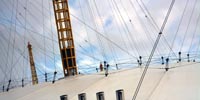
I had a lot of involvement with the extraordinary Millennium Dome at Greenwich. Right from the early stages through a lot of input to the Learn Zone where of course the then World's Largest Internet Learning Project (according to the Guinness Book of Records) our Tesco Schoolnet 2000 (with Bob and Carole Fletcher-Hart's Intuitive Media) was celebrated.

Virtual places:
Over the years I've been lucky enough to be engaged in some of the most ambitious, and pioneering, on-line learning projects - and that meant designing some on-line spaces and places and community tools as far back as the late 80s and then, with the Internet, the early 90s. I'll try (but slowly...) to assemble them into some narrative form here... designing these things is spectacularly complex; few realise just how much so. If you care about learning in virtual spaces, these links might well become a useful primer, eventually!
...before the Millennium the Tony Blair government made a promise of one email address for each child. This was partly a result of the Stevenson Report which I helped Dennis Stevenson and a few others to write and which heavily informed the incoming Labour government's policy. It was clear even then that identity was crucially important in future learning... but the promise ebbed away. A few unenlightened corporates had lobbied the gov. to the effect that email was their job, not government's and... it was gone.
But not forgotten! I'd been working with Oracle on the design for the MillieMail service and that design, with Oracle's backing became the prototype codenamed as Scoop. You can listen to a commentary and see the original screenshots from here. Scoop was previewed at Tomorrow's World Live in London to great amazement. I remember showing Scoop to Oracle's Larry Ellison (I'm a Larry fan - not just because of his sailing, but because he really does care about, and empathises with, children who have less advantages than many) in California and he ran boyishly all round his office saying "this is what databases can do.. this is what they are for!!". He was as excited as I was, with his real concern for inclusion, and we had fun together considering the potential. He backed Scoop massively with his own money - without asking for media hype or recognition - and it became the excellent (and free) Think.com
Some years back I was asked by the Blair government to build an online community of English and Welsh headteachers. They had seen the collegiality and mutuality that resulted from putting children together on-line in Tesco Schoolnet 2000, Schools OnLine and so on (which I was lucky to be centrally involved with). The initial community of 1,000 heads grew rapidly into all 21,000 head teachers and the quality of discourse that resulted was remarkable nd helped everyone to focus on the internal expertise of that particular community of practice. This link is to the original CD ROM that we sent out in 2001 to them all - including video clips from many involved from the Prime Minister upwards. Nowadays, this all part of the National College of School Leadership of course.
 |
 |
last edited on Thursday, April 3, 2014 8:37 AM